Most of us have owned at least one piece of furniture that didn't make it past a house move. A wobbly bookshelf, a table with a peeling edge, a bed frame that started creaking after a year. It's so common that there's now a name for it: fast furniture.
So how long should furniture actually last? And does buying better really save money in the end? Here's what the research says.
What is fast furniture?
Fast furniture is cheap, mass-produced furniture that's designed to be bought quickly and replaced quickly. Think flat-pack pieces made from particleboard or MDF with a thin surface on top. It's the furniture version of fast fashion.
Researchers describe fast furniture as typically lasting somewhere between one and five years, according to research presented at the PLATE 2025 conference.
What the research says
There's surprisingly little data on this, but what exists is telling.
-
In a US survey of 2,000 people reported by Furniture Today, 80% of those who'd bought fast furniture said they didn't expect it to last long. On average, they thought it would last about two years.
-
The same survey found 65% were more likely to throw fast furniture away than donate or sell it.
-
In the UK, a survey of 1,000 people reported by Furniture News found bed frames were being replaced about every 7 years, well short of the 10 years usually recommended.
-
Across Europe, around 10 million tonnes of furniture are thrown out every year, and only about 10% is recycled, according to a 2021 study by Cooper and colleagues.
In Australia, around 30,000 tonnes of commercial furniture waste is created each year and 95% of it ends up in landfill, according to DCCEEW figures shared by the Australian Furniture Association. But there's very little data on what happens to the furniture in our homes.
Why solid timber lasts longer
It comes down to what's inside.
Particleboard and MDF are made from wood fibres and glue pressed together. They're fine on day one, but they don't love moisture, screws loosen over time, and once the surface chips or swells, it usually can't be fixed.
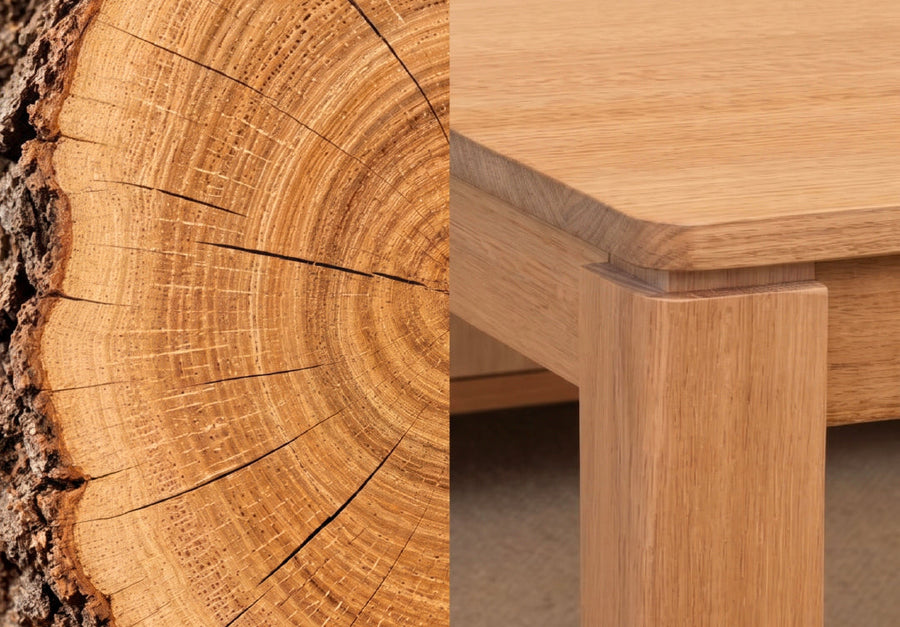
Solid timber is the same all the way through. Screws hold firmly. Scratches and water marks can be sanded out. The whole piece can be refinished if your style changes. That's why so many of the pieces people inherit from their grandparents are solid wood.
The real cost of cheap furniture
The price tag only tells you part of the story. A better way to compare is cost per year.
Here's a simple example using illustrative figures:
|
Flat-pack table |
Solid timber table |
|
|
Price |
$600 |
$3,000 |
|
How long it lasts |
About 4 years |
30+ years |
|
Cost per year |
About $150 |
About $100 |
Over 30 years, you might buy a cheap table seven or eight times. That's a lot of money, a lot of weekends assembling things, and a lot of furniture on the kerb.
How to make furniture last
Whatever you buy, a few habits help:
-
Use coasters and placemats, especially with hot dishes.
-
Wipe up spills straight away.
-
Keep timber out of harsh direct sun where you can, or rotate it now and then.
-
Lift heavy things instead of dragging them across the surface.
-
Re-oil or refresh the finish when it starts to look dry.
The heirloom mindset
The best furniture isn't just built to last. It's built to be passed on. A dining table that's hosted 30 years of birthdays and Christmas lunches carries a story no new piece can.
At The Acacia Tree, that's the whole idea. Every piece is made from Aussie-grown solid timber and built in Australia to be kept.
Common questions
How long should a dining table last?
A well-made solid timber dining table can last for decades and be refinished many times. Cheaper flat-pack tables often last only a few years.
Is solid wood furniture worth the money?
If you plan to keep it, usually yes. The cost per year is often lower, and it can be repaired instead of replaced.
What is fast furniture?
Cheap, mass-produced furniture designed to be replaced quickly, usually made from particleboard or MDF.